Why We Provide a Google Review Funnel Without Review Gating
Review gating can look like a shortcut to a 5.0 rating. Here is why Review Revolution built its Google review funnel to keep the public review link open to every guest, and what it does instead.

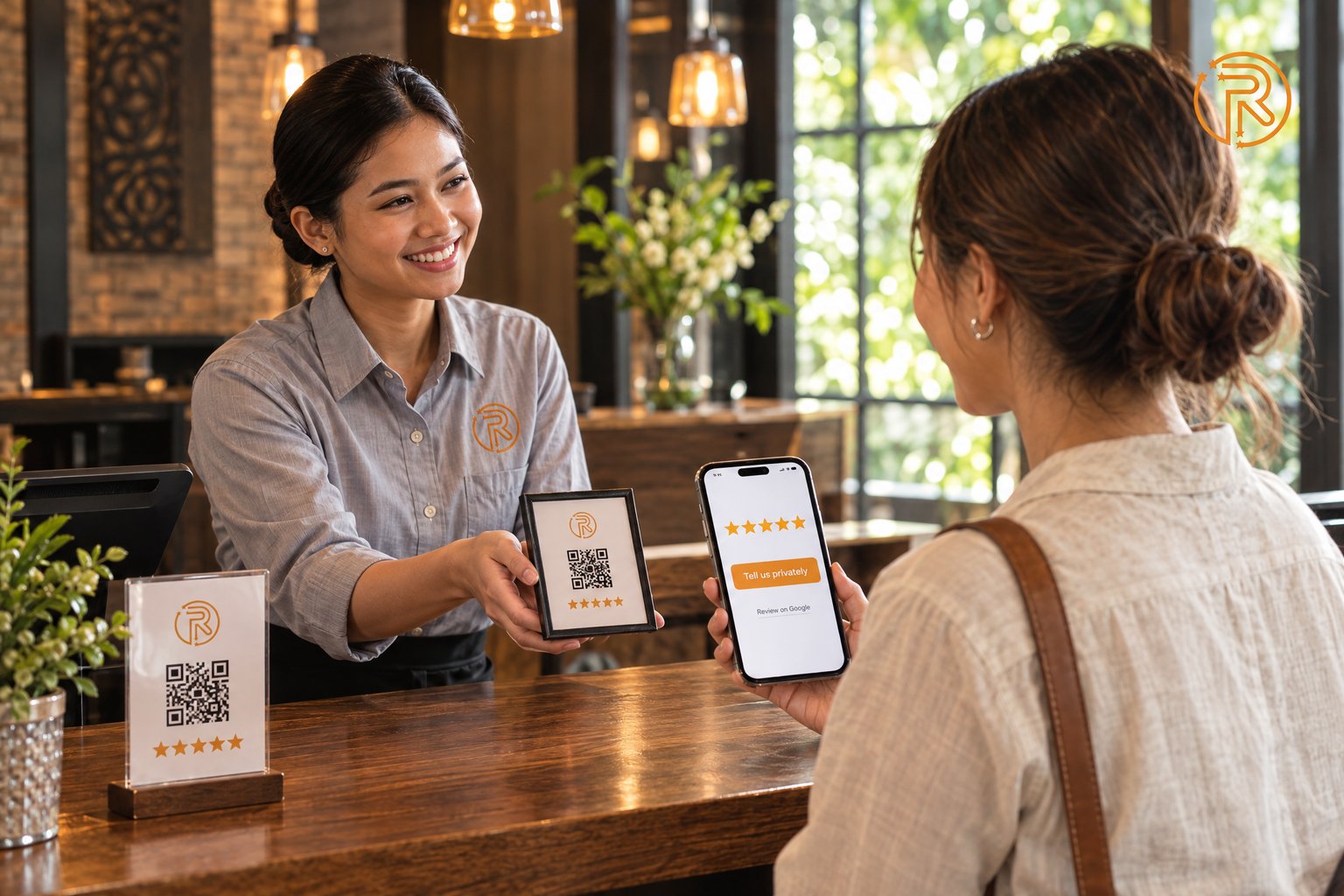
Review gating is the practice of asking customers how their experience went, then sending happy ones to a public review site and unhappy ones to a private feedback form. It is tempting because it makes a rating climb fast. It is also exactly what Google's policy tells businesses not to do.
We provide a Google review funnel without review gating on purpose. This article explains what gating is, why it backfires, and how our funnel collects private feedback and public reviews at the same time without shutting anyone out.
What Review Gating Actually Is
Gating is selective solicitation. A business asks for a rating first, then only shows the public review link to people who score high. Common versions include texting for a rating and requesting a Google review only from top scorers, or offering a discount on a future visit in exchange for five stars. The common thread is that the business decides whose opinion reaches the public. What shows up on Google stops being a fair sample of your customers and becomes a curated one.
What Google's Policy Says
Google's prohibited and restricted content policy for reviews lists, under fake engagement, "discouraging or prohibiting negative reviews, or selectively soliciting positive reviews from customers." Older versions of the guidance said much the same in different words, so this is not a new rule. A funnel that hides the Google link from unhappy guests falls under it. Read our Google review guidelines for businesses for the full picture, and what review gating is for the definition in more depth.
Why Gating Backfires
The policy risk is real: reviews can be removed and a listing can be restricted. Regulators are paying attention too, and the FTC has taken action against fake and manipulated reviews. But the commercial reasons matter just as much. A profile with only glowing reviews looks curated, and shoppers who sense filtering stop trusting every review on it. Unhappy guests who are blocked from speaking publicly often complain elsewhere, on social media or other sites you do not monitor. And a rating inflated by gating tells you nothing, so you lose the honest signal you need to fix the experience.
How Our Funnel Works Instead
A guest scans a Google review QR code or opens a follow-up email and gives an honest rating. A high rating leads to a clear public review step. A low rating opens a private form so a manager can follow up and fix the problem. Under that form, a smaller link to the same Google listing stays visible, so a guest who still wants to post publicly can do so without submitting private details first. Nobody is blocked, nobody is asked to raise a score, and no one is offered a reward for a particular rating. The review funnel and the negative review filter are a first step toward recovery, not a wall.
What You Gain Without Gating
You still get early warning. Private feedback reaches the right person within hours, which turns many unhappy visits into recoveries before a one-star review is written. You get an honest rating that customers believe, which converts better than a perfect score they doubt. And you stay inside the rules, so the reviews you earn are not at risk of removal. The funnel changes the order of the conversation, with a private route offered first, but it never removes the public option.
Ask Well Instead of Filtering
You do not need gating to get good reviews. Ask soon after the visit while it is fresh. Invite rather than pressure, and never ask for a specific star count. Keep the request short, personal, and easy to complete with one tap. Explain why reviews help a local business. Then reply to every review, including negative ones, promptly and politely. Our guide on how the review funnel works ethically covers the routing logic, and the wider Google reviews hub collects the rest of the playbook.
A funnel that decides who may speak publicly is not a funnel. It is a filter, and Google calls that review gating.
Route Feedback, Never Block It
Run a compliant Google review funnel with Review Revolution: branded QR codes, private recovery for unhappy guests, and a public Google path that stays open to everyone.
이 과정을 완전히 자동화하고 싶으신가요?
시작하기자주 묻는 질문
What is Why We Provide a Google Review Funnel Without Review Gating?
Review gating can look like a shortcut to a 5.0 rating. Here is why Review Revolution built its Google review funnel to keep the public review link open to every guest, and what it does instead. Review gating is the practice of asking customers how their experience went, then sending happy ones to...
Who is this for?
Businesses looking to grow their online reputation and Google reviews.
관련 페이지
Features
리뷰 퍼널
만족한 고객을 공개 리뷰 플랫폼으로 안내하고 부정적인 피드백을 비공개로 수집하는 Google 리뷰 퍼널. 지역 비즈니스를 위한 윤리적인 리뷰 생성.
Blog
리뷰 퍼널 완전 정리: 공개 리뷰 전의 비공개 피드백
스마트 퍼널이 만족한 손님을 Google로 안내하면서 건설적인 비판은 먼저 내부적으로 포착해, 평점과 관계를 함께 보호하는 방법.
Features
Google 리뷰 QR 코드
테이블, 카운터, 마케팅을 위한 Google 리뷰 QR 코드 생성기. 리뷰 수와 로컬 SEO를 높이는 브랜드 리뷰 QR 코드.
Features
부정 리뷰 필터
공개 리뷰 사이트에 도달하기 전에 부정적인 피드백을 비공개로 수집하세요. 윤리적인 비공개 피드백 수집과 해결 워크플로로 평점을 보호하세요.
Blog
비즈니스를 위한 구글 리뷰 가이드라인: 해도 되는 것과 하면 안 되는 것
인센티브, 가짜 피드백, 또는 프로필을 위험에 빠뜨리는 선별적 게이팅 없이 투숙객에게 구글 리뷰를 요청하는 명확하고 정책에 안전한 플레이북입니다.
Blog
What Is Review Gating? Google's Policy and How Compliant Tools Invite Everyone
Review gating is asking only happy customers for a public Google review. Here is what Google prohibits, how major platforms invite every guest, and how a private form can sit next to an open Google link.